Receiving a head of state in Tokyo is not just about rank. This also relates to imperial time itself, which the first state guest of the Reiwa era demonstrated, without fully knowing it.
A status before a rank
In most capitals, precedence is calculated. In France as in the United States, official texts set ranks, dates of taking office, and protocol orders that can be consulted in black and white. Japan does things differently. Before even talking about place at the table or order of arrival, we must first obtain a status: that of State Guest.
This status is not automatic. It is granted by an official invitation from the Japanese government, reserved for heads of state and personalities of equivalent rank. Once this status is obtained, a sequence is put in place, almost always identical in its structure: welcome ceremony, imperial audience, state banquet at the Imperial Palace, then courtesy call before departure. It is this architecture, more than the rank itself, which organizes Japanese protocol.
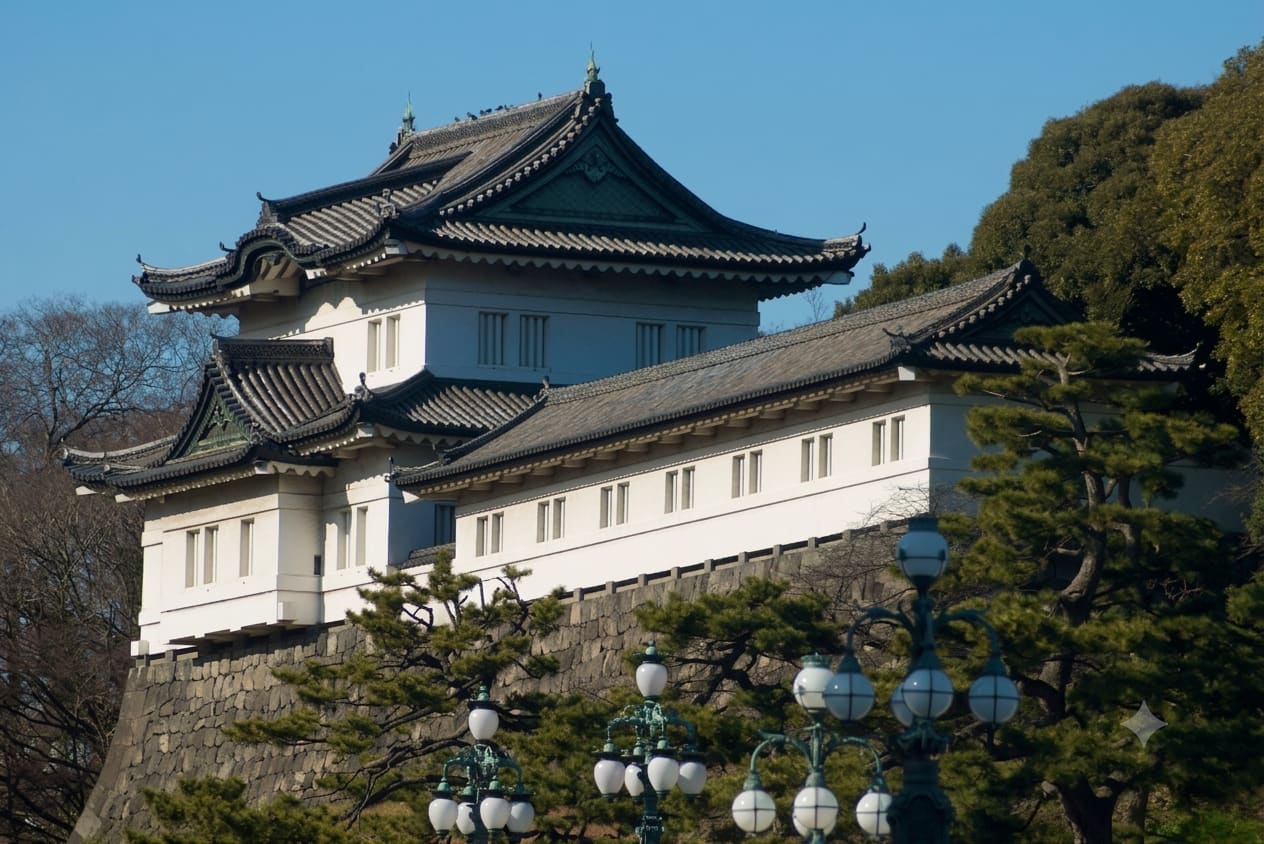
The Imperial Palace, the only possible scene
The location matters as much as the sequence. The Japanese state banquet is not held in a government residence or ministry. It is held at the Imperial Palace, under the authority of the emperor himself. This imperial centrality clearly distinguishes Japan from Western models, where the head of government or elected head of state generally presides at the head table himself.
In Japan, the receiving figure is not the Prime Minister, head of government, but the Emperor, a symbolic and constitutional figure. The reception protocol thus clearly distinguishes two layers of Japanese power: the imperial layer, ceremonial and supreme, and the governmental layer, where political and economic issues are negotiated. A bilateral summit can thus combine the two registers in the same visit, without them ever being confused.
The Trump-Naruhito case, May 2019
The most documented case of this mechanism remains Donald Trump’s visit to Japan, on May 27 and 28, 2019. This visit presented a rare feature in the global protocol calendar: it made Trump the first state guest received by Emperor Naruhito after his enthronement, which occurred a few weeks earlier. Trump himself highlighted this special place during his banquet speech, speaking of the honor of ushering in this new imperial era as its first foreign guest.
This sequence illustrates a principle specific to Japanese protocol: precedence can be read not only in the rank of the visitor, but also in their position within the imperial calendar. Being the first guest of a new era constitutes, in itself, a form of protocol distinction, independent of any traditional diplomatic classification.

What we can say, what we can’t
It is appropriate here to mark a clear boundary, essential to the rigor of this issue. What the sources establish with certainty: the existence of the status of State Guest, the four-part sequence, the holding of the banquet at the Imperial Palace, and the symbolic place of first state guest of the Reiwa era occupied by Trump in 2019.
What the sources cannot confirm: the nominative details of the table plan for the 2019 banquet, nor the precise meaning of each protocol neighborhood. Japan, unlike some publicly available American records, does not systematically broadcast the exact placement of its imperial banquets. Any assertion on this point would amount to speculation, which this media refuses to accept.
A diplomacy of time rather than a diplomacy of rank
What the Japanese case teaches, ultimately, goes beyond Japan alone. He reminds us that a national protocol is never limited to a table of precedence. It can also be built around a calendar, a dynastic continuity, a temporality specific to the receiving institution. Where other nations codify their state hospitality by decree or court tradition, Japan codifies it by imperial time itself.