Emmanuel Renaut and local diplomacy at the G7 in Evian
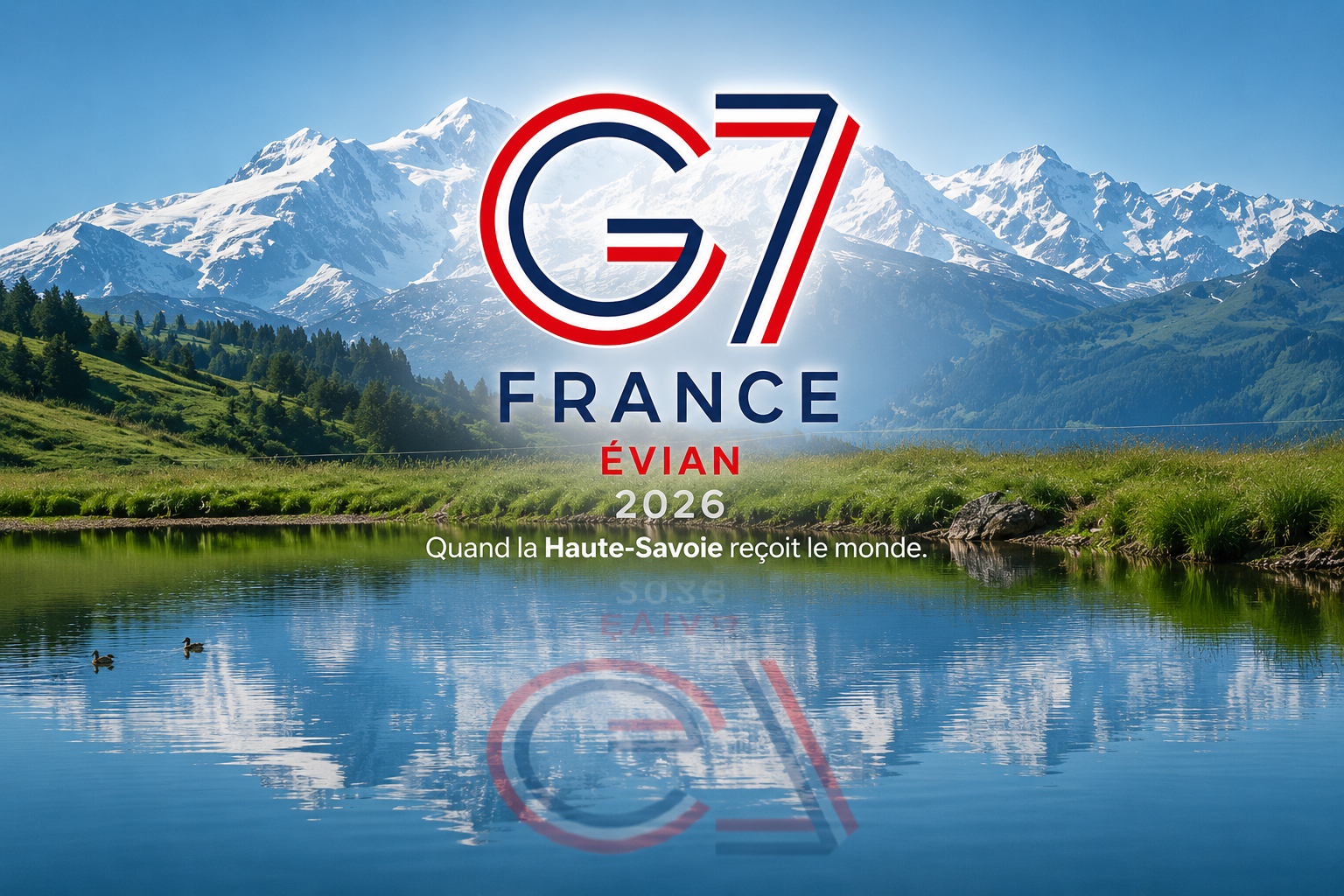
On June 15, 2026, to open the G7 summit, France did not entrust its most strategic table to a Parisian palace, but to a mountain chef. Behind the Arctic char and Chartreuse veal served at the Hôtel Royal d’Évian lies a doctrine: making terroir an instrument of influence. Reading a choice that is not insignificant.
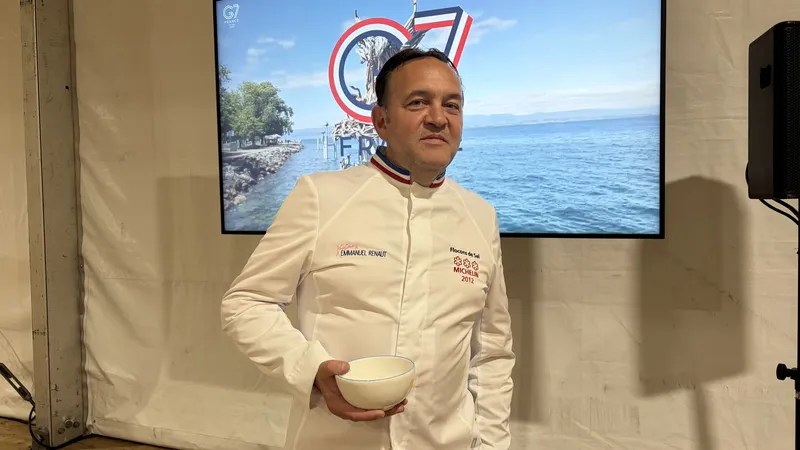
Chef Emmanuel Renaut, three-starred and best worker in France Source: FTV/Sylvia Bouhadra
A working dinner, not a gala dinner
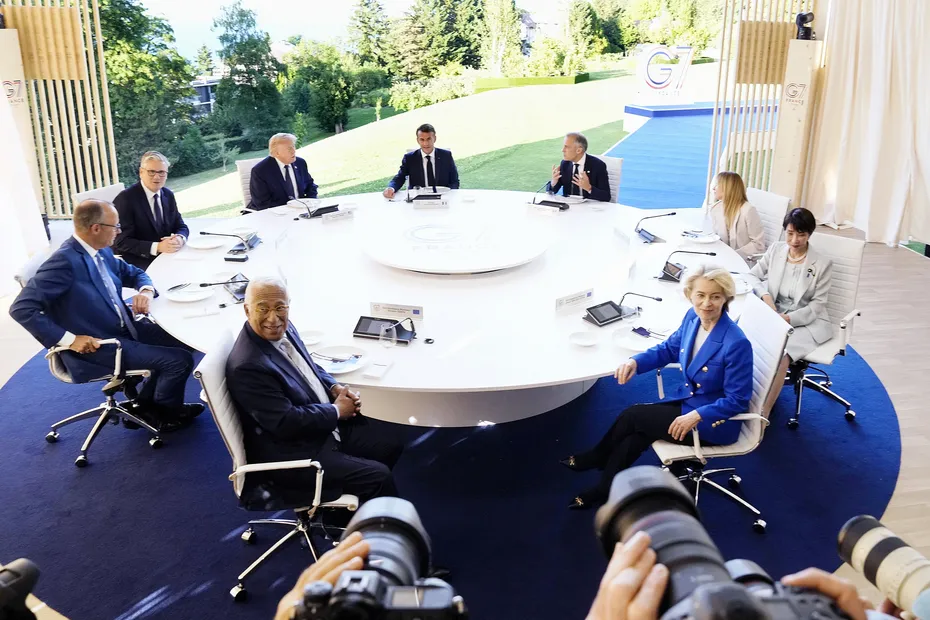
8:30 p.m., Monday June 15, 2026. On the south shore of Lake Geneva, in the grand salon of the Hôtel Royal d’Évian, the heads of state of the G7 take their places around the same table. The summit has, strictly speaking, not yet started: it opens with this meal, placed under a programmatic title — responding together to major international issues. Nothing about a fixed ceremonial. The guests chat while eating, the dishes follow one another without emphasis, and we quickly understand that this first evening is not intended to dazzle, but to loosen tongues.
This is precisely where the subtlety lies. The next day, June 16, Emmanuel and Brigitte Macron will offer a real gala dinner in honor of all the delegations and their spouses. But the meal which inaugurates the summit is of another register: that of the working dinner, where the heads of state get to the heart of the issues away from the cameras. “It was really a working dinner,” confirmed the man who signed the menu – a chef who, for the occasion, had left his Savoyard stoves for a summit.
This chef is Emmanuel Renaut. And the fact that the Republic has chosen, for this opening moment, a mountain cook rather than a figure from the great houses of the capital is not a logistical detail. It’s a message. You still need to know how to read it.
The Picard who became a Savoyard
To understand the scope of this choice, we must first understand who the man called to the kitchens of the Hôtel Royal is. Emmanuel Renaut is not a child of the Alps. Born in the Paris region, raised in Laon, in Aisne, in a family of fishmongers of Picardy origin, he grew up far from the peaks which are his signature today. He chose the mountain; he did not receive it as an inheritance. This is undoubtedly what gives its Savoyard roots this particular intensity, that of the loyalties that one owes only to oneself.
Its trajectory has the rigor of a French course of excellence. Trained at Crillon, at Ambassadeurs, in Christian Constant’s brigade - alongside, among others, Éric Fréchon and Yves Camdeborde -, he then spent seven years as second to Marc Veyrat, the master of Veyrier-du-Lac who will remain his mentor. A detour to London, where he managed the kitchens at Claridge’s, then a return to the summits: in 1997, he moved to Megève and opened Flocons de Sel there. First star in 2001, title of Meilleur Ouvrier de France in 2004, second star in 2006, and recognition in 2012 with the third star, the same year when his peers crowned him Chef of the Year. A member of the Grandes Tables du Monde, it has since spread out - the Auberge du Bois Prin in Chamonix, advisory tables as far as Switzerland and Santorini - but the Flocons de Sel remains its flagship, a refuge of blond wood clinging to the Leutaz road.
At Renaut there is a rare coherence between the man and the plate. He boasts a pure cuisine, nourished by lake fish, mushrooms, herbs and high altitude berries picked according to the seasons, and has never given in to one-upmanship. Revealing detail: in his houses, a file names the producers one by one, as we do justice to co-authors. The word “gastronomic”, moreover, makes him bristle. What he does, he readily says, is cooking — nothing more, nothing less. This modesty is not false modesty: it is a posture, almost an ethic. And it is exactly this posture that French diplomacy sought.
The plate as a message
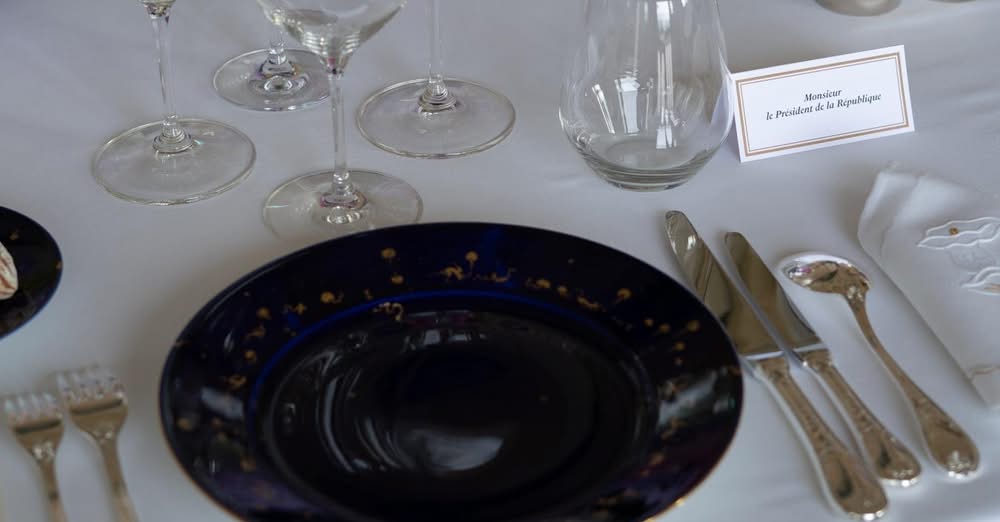
The menu served on June 15 is contained in a few lines, and it is in this very sobriety that its strength lies. Two starters around peas and mushrooms; for main course, arctic char — this noble fish from Lake Geneva — and Chartreuse veal; then cheeses, “of course”, and dessert. Nothing ostentatious, no excess of imported luxury goods. A short, readable, almost obvious map.
Obvious, really? Let’s take a closer look. The arctic char comes from the same lake which extends beneath the windows of the palace. The veal comes from the Chartreuse mountains, not far away. The cheeses are, logically, those from neighboring mountain pastures. The geography of the base follows, almost meter for meter, the geography of the summit. We do not serve the powerful of the planet a sample of French heritage: we serve them the place where they are. The terroir is not illustrated, it is summoned.
This choice is not improvised. Serving a lake fish and a local veal to seven heads of state is to affirm that at the highest level of representation, France does not need white truffles or caviar to make an impression: the depth of a just, grounded product is enough. Renaut also underlined this in his own way, by assuring that he had not received any particular instructions from his hosts – “We had no whims,” he said. The sentence, seemingly innocuous, says something essential: the table did not bow to the guests, it offered them a bias. And this bias was accepted.
This is what distinguishes gastrodiplomacy from a simple prestigious service. The plate becomes a grammar. The choice of a product, its origin, its cooking, the order of services: so many signs addressed to people who know how to decipher them. In Évian, the message was clear. Sobriety rather than pomp, roots rather than pomp, authenticity rather than pomp.
Source: Elysée Palace
The doctrine of terroir as soft power
France did not invent the art of governing through the table yesterday. At the Congress of Vienna in 1815, Talleyrand already knew that a well-kept kitchen opened doors that classical diplomacy kept closed; For this he had brought along Antonin Carême, this genius pastry chef who will be nicknamed “the king of chefs and the chef of kings”. De Gaulle receiving the Kennedys at Versailles in 1961, the major state dinners of the Fifth Republic, the inclusion of the “gastronomic meal of the French” as a UNESCO intangible heritage in 2010, the launch of the Goût de France operation in 2015 under the leadership of Laurent Fabius: cuisine has long been an acknowledged pillar of French influence.
But the choice of Évian marks a shift that deserves attention. Classical gastrodiplomacy spoke the language of the capital and the great century – gilding of Versailles, splendor of the Élysée, virtuosity of Parisian palaces. When Emmanuel Macron received Vladimir Putin at Versailles in 2017, all the symbolic power of the disappeared monarchy was mobilized. In Évian, in 2026, the situation is the opposite. It is no longer historical grandeur that is being showcased, but territorial anchoring. Prestige is decentralized. He leaves the marble galleries to reach the banks of a lake and the pastures of a massif.
This move is not a concession to modesty: it is a strategy. In a world where authenticity has become a sought-after value, where climate and food issues reach international summits, terroir constitutes a new kind of soft power. To highlight a three-star Savoyard chef, seasonal products, a short chain of named producers, is to hold a speech without pronouncing it: that of a France which claims its regions as a diplomatic wealth in their own right. The terroir becomes a geopolitical argument, and the plate, the vector of a certain idea of the country.
The location is part of the menu
This consistency does not stop at the edges of the plate; it permeates the entire decor. The Hôtel Royal belongs to the Evian Resort, a vast estate of nineteen hectares overlooking Lake Geneva, owned by the Danone group - the same group whose water has made the city world famous. The five-star palace, isolated in its park, overlooks the lake from which the arctic char for dinner was taken. The container and the content respond to each other: the place is not only the setting of the meal, it extends its purpose.
This choice of an isolated palace owes nothing to chance. Its director, François Dussart, admitted it bluntly: a resort closed in on itself, on the edge of a lake, is more easily secured than a city center establishment. Experience also weighed in the balance, because Évian was not his first attempt. The resort had already hosted the G8 in 2003 - at the same Hôtel Royal -, making it the first French city to host the world’s powerful people twice. Twenty-three years separate the two meetings, and the continuity of the place alone speaks of the loyalty of French diplomacy to its regional settings of excellence.
The system, naturally, was commensurate with the event: thousands of agents mobilized, a vast protection zone extending on both sides of the Franco-Swiss border, a restricted airspace above Lake Geneva. Meanwhile, a few kilometers away, Brigitte Macron received the First Ladies in the medieval city of Yvoire, emptied of tourists for the occasion. Everything in this scenography worked towards the same effect: making a corner of Haute-Savoie, for three days, a capital of the world. And at the heart of this deployment, the Renaut table played its role, modest in appearance, central in reality.
The table, discreet instrument of the State
We will remember the Evian G7 for its final declaration, its positions on Ukraine, its corridor negotiations and what commentators have already called the “Evian moment”. We will perhaps forget that all this started around a working dinner, on a Monday evening, in front of arctic char and Chartreuse veal. Yet it is there, in the informality of a meal, that the first threads of great agreements are traditionally tied. The first dinner at a summit is never quite a dinner: it is a threshold, the moment when heads of state leave the register of protocol to enter that of conversation.
That France has chosen to cross this threshold with a mountain leader and a menu rooted in its land says a lot about the diplomacy it intends to embody. Not the power that imposes, but the nation sure of itself to the point of receiving the world without ostentation, by the sole accuracy of what it is. Emmanuel Renaut, who hates the word “gastronomic” and who names his producers one by one, was the exact man of this grammar.
This is the paradox of local gastrodiplomacy: its sobriety is its sophistication. Where other tables would have sought to dazzle, that of Évian chose to signify. And when the communiqués have yellowed, when the analyzes of the summit are archived, what will perhaps remain of this June 15, 2026 is this simple and enduring image: seven heads of state gathered at the edge of a lake, eating fish from this lake, prepared by a man who had made the mountain his adopted homeland.
Source: Elysée Palace