The history of civilization changes the day humanity discovers that a handful of earth heated in a fire can become a durable object.
This invention seems simple; yet it radically transforms the relationship of human societies to time, food and territory.
Ceramics was born even before organized agriculture.
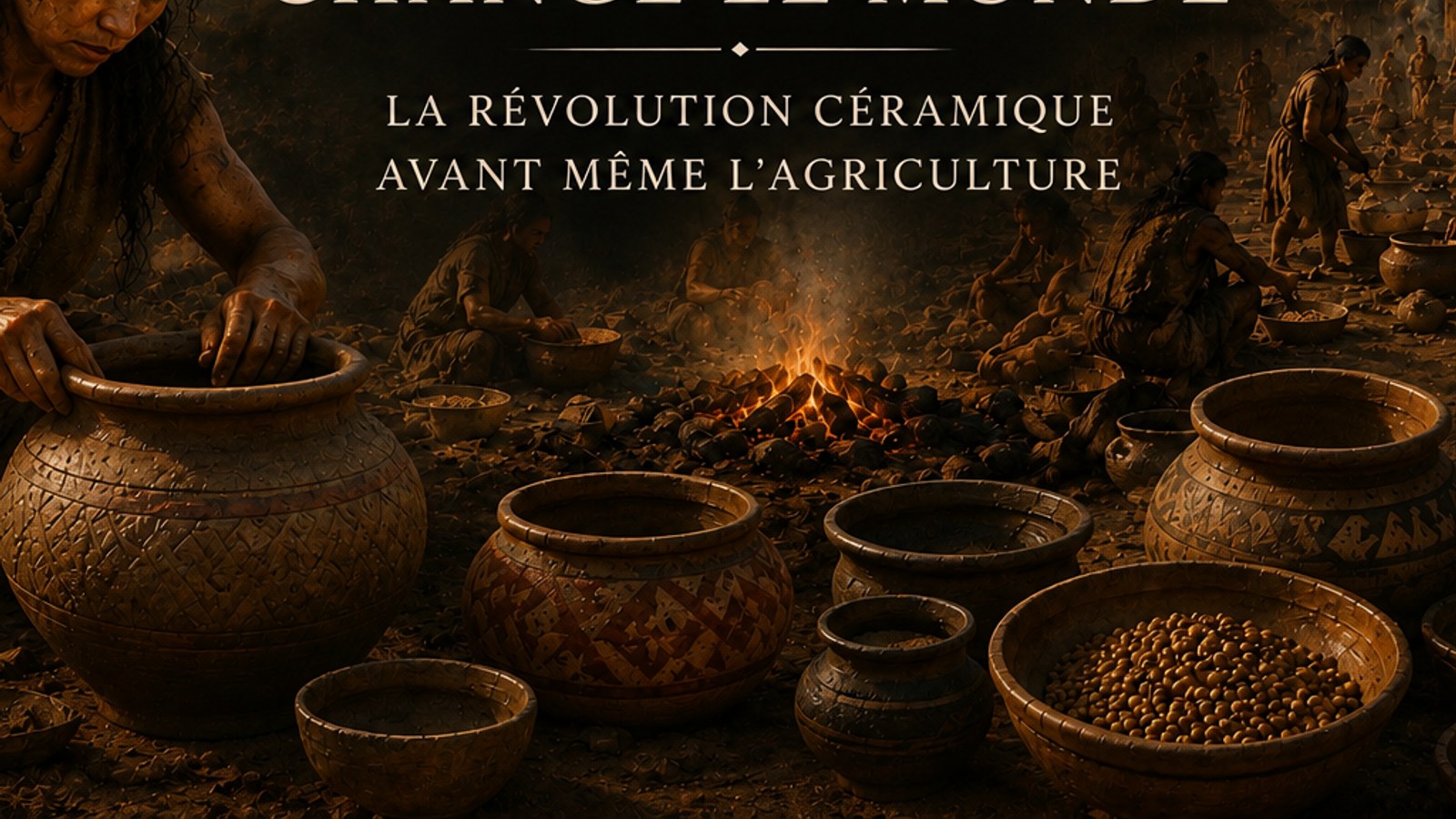
The first known pottery appears in the Far East. In Japan, hunter-gatherers of the Jōmon culture made hand-shaped vases fired in the open air as early as 14,500 BCE. Their pointed-bottomed containers are used to cook broths, preserve food and store seasonal resources.
For the first time, food can be processed slowly, shared more widely, and stored longer. Cooking in water profoundly modifies human nutrition.
In Neolithic China, the sites of Yuchanyan and Yangshao reveal another revolution: ceramics gradually became an aesthetic and cultural support. The painted decorations, geometric patterns and codified shapes show that the container already exceeds its utilitarian function. The vase becomes a sign of social identity and symbolic transmission.
In the Middle East, the first large agricultural communities soon used clay to store cereals, beer and oils. The jars make it possible to accumulate reserves, therefore to organize permanent villages, exchanges and collective banquets. Ceramics thus accompanied the birth of the first complex societies.
This silent revolution changes everything: thanks to clay, humanity gradually ceases to live only in the moment. The container becomes memory, reserve and power. From the first Jōmon bowls to the future Chinese imperial porcelain, the same idea has already spanned the millennia: transforming matter to better organize the world.