
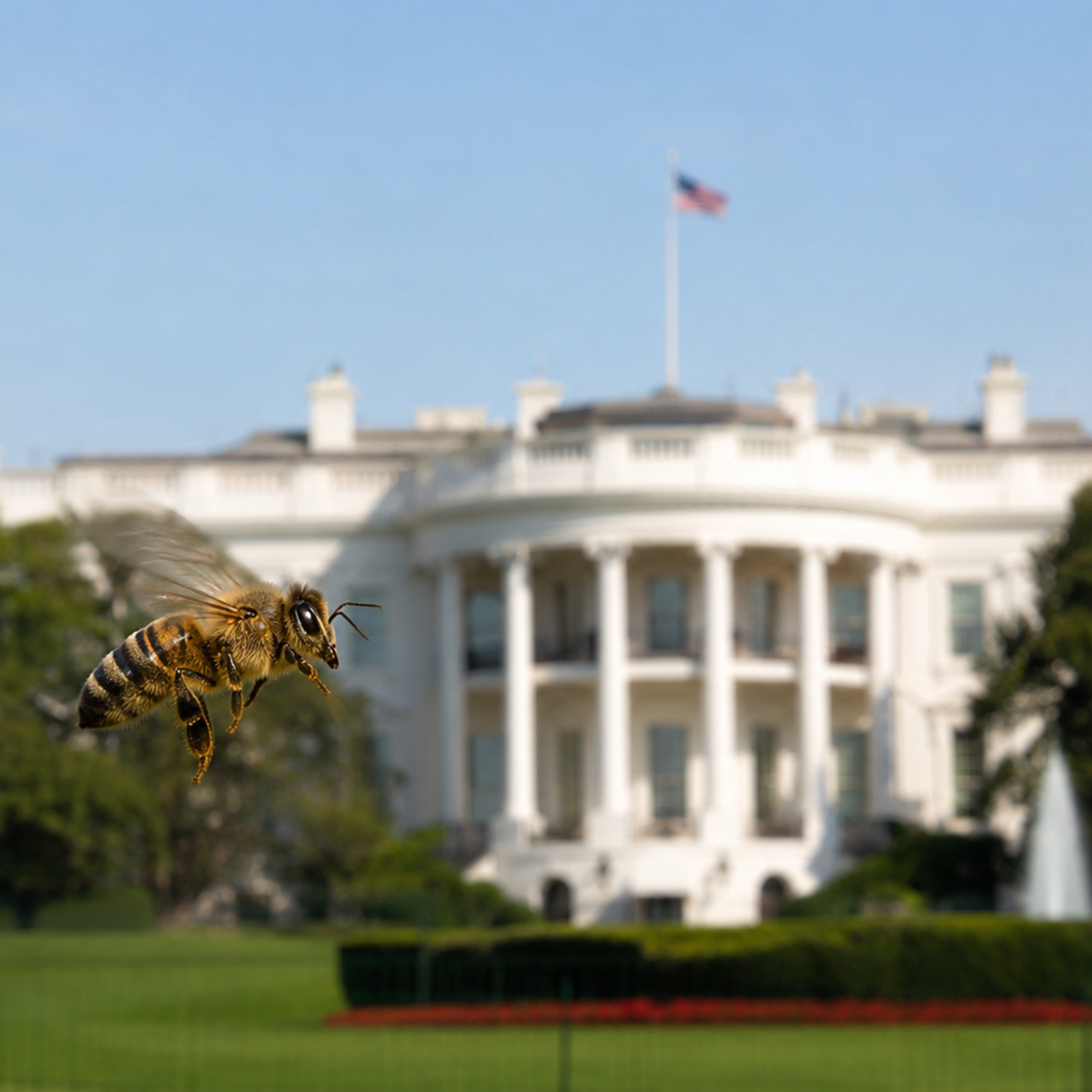
From the White House to Buckingham, from the French Senate to the Vatican, the palaces of the 21st century are now home to tens of thousands of bees.
Investigation into a quiet revolution.
Since the beginning of the 2000s, a discreet evolution has taken over the residences of power: on the roofs, in the walled gardens, between two security devices, beehives have been set up where only ushers and guards in full dress were expected.
It often starts with an intuition. In 2009, Michelle Obama planted a vegetable garden on the South Lawn of the White House; a passionate carpenter places one of his personal beehives there. The gesture, almost domestic, becomes symbolic: the first American presidential colony of the modern era today produces up to one hundred kilos of honey per year, served at the chef’s table, offered as a state gift, donated to food banks.
The story seduces because it is made up of encounters. In January 2021, Emmanuel Macron met a thirty-eight-year-old Norman beekeeper, Xavier Frémin, in Tilly. A few weeks later, two hives were set up “at the bottom of the garden, near the fountain” of the Élysée. In London, Charles III – a beekeeper at heart long before he was king – spread his beliefs from Highgrove to Clarence House, where honey and wax nourish Garden Parties and state dinners.
But the most beautiful secret is perhaps the oldest. In the Jardin du Luxembourg, an apiary school has been keeping watch since 1856, heir to a tradition born in 1818, training dozens of beekeepers each year under the foliage of the Senate. The Grand Palais has just found its bees in the summer of 2025, perched on a roof overlooking more than three thousand trees.
This movement is not anecdotal. Behind each hive lies a new grammar of prestige: biodiversity as a standard, the pollinator as a sentinel, the pot of honey as a diplomatic object.
In Canberra, Parliament offers its honey to foreign dignitaries; in Edinburgh, red wax seals the official acts of the kingdom.
The palaces of the 21st century have understood this: we no longer govern only by force and solemnity, but by life.
The bee, tireless and fragile, has become the ideal ambassador of a power that wants to show itself attentive to the world.